

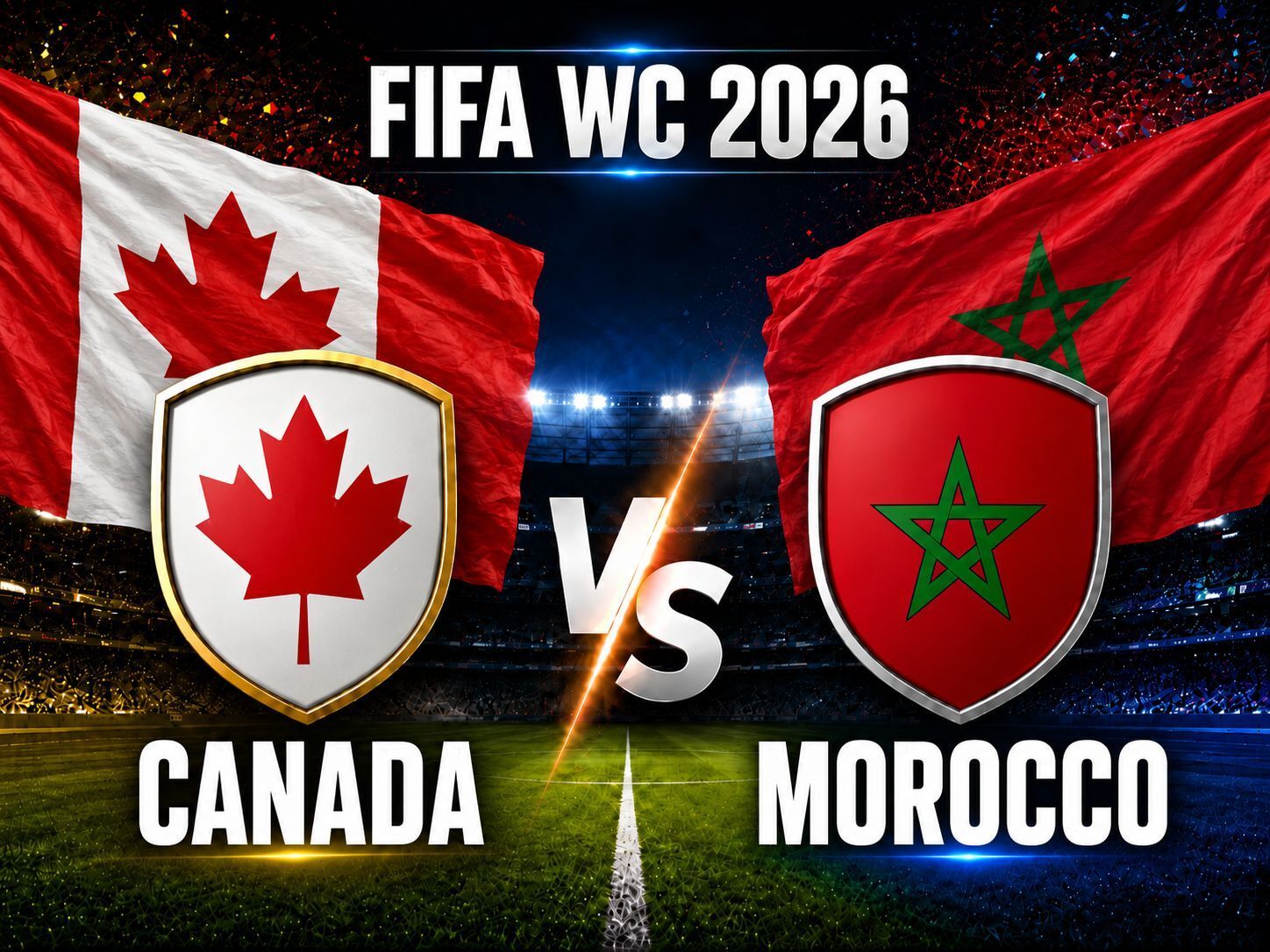
How Canada approaches the match
I like Canada’s emotional temperature. Jesse Marsch’s team runs hard, attacks vertically and tries to turn the match into a race. Across four tournament games Canada have scored 9 and conceded 3. The best version of them appeared in the 6-0 against Qatar, where they produced 4.46 xG and flooded the box all night. Against Bosnia they posted 1.25 xG, against Switzerland 1.34 xG, and the South Africa game was tighter, uglier, more adult. That last result matters. Canada did not need chaos to win.
The strengths are obvious: Jonathan David and Cyle Larin give penalty-box presence, Buchanan and Laryea carry the ball into space, and Davies changes the geometry of the pitch if he starts. The weaknesses are also visible. Canada can lose control after turnovers, their full-backs leave space, and the absence of Ismaël Koné hurts midfield balance. Eustáquio and Alfie Jones had knocks before the last match, while Davies returned from the bench and remains the key tactical variable. I expect Canada to press Morocco’s midfield early and attack the channels quickly, especially if Hakimi pushes high.
How Morocco approaches the match
Morocco look like a more tournament-ready side. They were unbeaten in Group C, held Brazil, then survived the Netherlands after 120 draining minutes. That match says a lot about them. Morocco created 1.4 xG, allowed only 0.23 xG over 120 minutes, equalised late through Issa Diop, then trusted Bounou in the shootout. This is a disciplined, flexible team that can play with the ball or without it.
Saibari is in excellent form, Brahim Díaz and Hakimi drive progression, and Ounahi with El Aynaoui can slow the game to Morocco’s preferred rhythm. The concern is fatigue. A knockout match that goes to penalties leaves a mark, even on a deep squad. Still, I trust Morocco’s structure more than Canada’s. They did concede twice to Haiti, so transitions can hurt them, but the overall defensive platform is stronger, and Bounou is a major asset in any low-margin game.
What happens if the match is tied after 90 minutes
If the score is level, we get two extra periods of 15 minutes, then penalties if needed. That scenario feels very live to me. Canada’s intensity can be a weapon early, but extra time asks different questions. It asks who still has legs, who can manage spaces, who has a bench prepared for a second match inside one night. Canada’s running power is dangerous, but Morocco’s game intelligence and goalkeeper edge become more important as the match stretches. Bounou already proved his penalty value against the Netherlands, and Morocco’s penalty confidence is not theoretical anymore.
Match prediction and the team that will advance
I expect a cautious first half, Morocco with more of the controlled possession, Canada hunting triggers and direct breaks. The market leans that way too. Under 2.5 goals is -150, and I agree with it. Both teams arrived here through tight knockout wins, and this has the shape of another low-event game. My estimated 90-minute probabilities are close to 18 percent Canada, 27 percent draw, 55 percent Morocco, which fits the available model and broadly explains Morocco at -120.
My main bet is Under 2.5 goals at 1.67. The alternative is Morocco draw no bet, or Morocco to qualify if the price is reasonable. My probable score after 90 minutes is 0-1. The chance of extra time is significant because Canada can make this physically awkward, but if I have to choose the team that advances, I stay with Morocco. They are more composed, more tactically adaptable, and in a knockout match like this, those qualities usually cash more often than pure momentum.